
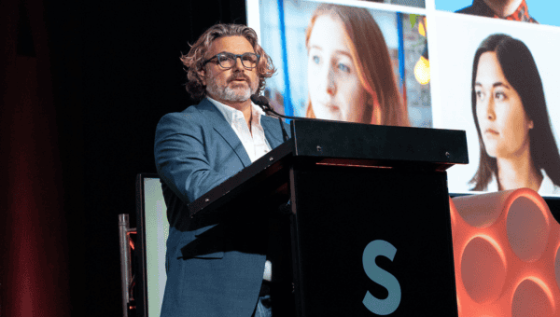
OPENING ADDRESS FOR SCREEN FOREVER 38
Matthew Deaner, CEO, Screen Producers Australia
This year there are over 150 domestic and international speakers across 40 highly impactful sessions – each one carefully curated from 6 months of advisory board and industry consultation. Here are some highlights:
You can hear about what is happening with streaming regulations in Canada and Ireland as well as here with Taming the Global Streaming Tiger!.
Tap into some practical knowledge for preparing to go into production in different parts of the world with I Wish I Had Known This Before.
We take a close look at non-scripted production and programming with We Need to Talk About Factual!
Looking outwards, we have an exclusive In Conversation with screen legend Ron Howard and his producing partner, William Connor.
We sit down with Alon Aranya, the man behind Tehran and Your Honor.
We include our international guests on The Decision Makers panel as well as across panels on private financing in How to Make it Rain and we hear from the big three in Meet the Commissioners: New Zealand.
Reflecting on the impact our talent can have, we hear from new voices in the New Wave of Aussie Talent, and we learn what it takes to make Your Next Hit Show and Finding the Creators.
We are finally Getting Over Ourselves and the Cringe of Aussie Horror and we will put First Nations Voices Front and Centre with Collaboration in a New Era of Truth Telling.
We will Meet the Buyers and we will Meet the Funders, we’ll interrogate the impacts of Aussie Feature Animation, Artificial (or “alternative”) Intelligence, and Online Creation.
We will invite a noisy and opinionated discussion on whether Diversity is for Hire? and we even run a Brains Trust experiment in what it could look like to Brand Australian Stories to the world. PHEW!
There are many people who have contributed to the many aspects of this event behind the scenes, but I wanted to spend a couple of moments to single out a few people.
Let me start by acknowledging all the session producers (giving of their valuable time to produce these sessions) and the Market and Programming Advisory Boards (our panel of industry leaders who have helped shape this event and the outcomes it aims to deliver).
In terms of the SPA staff – let me start with our COO: Glenn Hamilton – who mostly –calmly and with good humour brings all the threads of this very complex undertaking together.
Next is our Director of Marketing, Events and Partnerships: Samantha Gill who leads the production team and works closely with our valued partners.
Bee Yurdakul is our Senior Event Producer and drives all the details in this event from start to finish.
Our Marketing and Comms Manager: Aidan McLaughlin who is responsible for all our comms across all channels and socials supported by returning legend – Georgia Kinninmont.
Simone Hulse and Rob Crawford who run the production of the event on the ground.
And then just a whole heap of wonderful people – some permanent at SPA – and some that have come to help us out for a few weeks: Brad Taylor – who just passed a 10-year milestone earlier this year with SPA – congratulations Brad, Renee Richardson, Sharmini Caldwell, Chrysa Christopher, Yolandi Franken, Geneva Valek, Jane Mulligan, Zoe Angus, Andy Barclay, and Kelly McNamara.
2 more to single out – for SPA Connect – Michelle Hardy again assembling a local and global marketplace masterpiece.
And rounding it out with – Jessica Giacco who has designed and delivered another high impact, highly relevant program. Congratulations Jess
Please join with me in thanking the team.
Let me finish by introducing our second SPA baby – Rasmus Hempstead Barclay – who is Andy’s second child. Andy did the hosting yesterday for Ireland Connect and is either going to collapse in a heap tonight or party like its 1999.
NOW – Just as it takes a village to raise a child, it takes a committed group of partners to be able to deliver this event. There are 29 of them – so I won’t run through every single one but:
Our Major Partner is the City of the Gold Coast – we all know to be a really important production hub and a fantastic city where the people work hard, play hard and relax hard.
Our Major Government Partner is Screen Australia who are central to this industry and central to our conference today.
Our Key Industry Partners are the ABC, Screen Producers Ireland, Media Super and SBS.
We have a swag of Supporting Partners who we are very grateful for and who care for our conference which in turn shows their care for you.
Thank you to our SPA Connect Partners – Screen Australia and Screenrights and again our Ireland Connect Partner – Screen Producers Ireland.
Thank you finally to our music, travel, and media partners – thank you.
But top of my list of thanks is our Principal the Queensland Government through Screen Queensland – who have been such a great partner to our industry and to this event.
Please welcome to the stage Jacqui Feeney to say a few words.
[Speech by Jacqui Feeney]
Thank you, Jacqui.
When we come together like this it always strikes me that we’ve got so much we can learn from each other and so much we can share. When approaching this in the right way – we can put down our differences and focus on what unites us as an industry, a tribe, a family. To face the challenges ahead together with a renewed sense of purpose and direction. To not just survive, but also to thrive.
Sometimes, from where I sit, it feels like we are walking a long tightrope, trying hard to keep our balance and stay upright and get towards the other side – get our projects financed, made, sold and shared – and all that that entails. Our industry is never static – the last year has shown us once again that we are strongly exposed to left field events way outside of our control – no one had a 118-day SAG-AFTRA strike on their dance card for last year, or a 148-day writers’ strike.
Despite these pressures, we are always seeking to keep some sort of balance:
between screen businesses small and large;
between those just embarking on their career and those with a huge legacy of achievement;
between growing our home-grown content and making space for international work; and
between the interests of producers and the others we work alongside like our actors/writers/directors and crew.
As the Nigerian poet Ben Okri said, “Stories are the secret reservoir of values: change the stories individuals and nations live by and tell themselves, and you change the individuals and nations.”
So, it is good to take stock of what it means to share our own culture, our own values, and our own stories with the rest of the world – and what it means in turn, to share theirs.
Right now, the Australian Government is also seeking to find some sort of balance: a regulatory balance between the cultural needs of Australian audiences, the commercial imperatives of streaming businesses – many of whom are global giants – and our industry and its ability to function successfully into the future.
What we are seeking is a sort of settlement about what Australian audiences are entitled to expect on these platforms, and how the Australian Government delivers on the commitment made to us in our National Cultural Policy more than a year ago.
None of this is easy or straightforward. If it was, it would have been done and settled years ago.
We had hoped that this legislation would have been in Parliament by now, but as of today, it is still a waiting game.
So, we continue to push on.
It’s not news to anyone in this room that the imperfect equilibrium that previously existed was long ago upended with the arrival of digital streaming platforms.
You only have to look at the current challenge to Australia from Meta over the News Media Bargaining Code to get a taste of how hard digital platforms both fight and test any Government moves towards regulation.
Even the toughest rules will be pressured for loopholes and fudging of figures. And even then, they can still be snubbed.
Getting some sort of settlement does feel closer than it ever has, but we don’t underestimate how hard getting this done is at all and the balancing elements in play for government seeking to find compromises in contested policy settings.
Until the last vote in Parliament, I can promise you right now, my team and I will keep working to support the industry to keep fighting as hard as we possibly can to get the best outcome we possibly can for you and for our industry.
Whatever the Government comes up with, we will be judging it to make sure it delivers sustainable growth for our industry through stable investment, in Australian stories.
The stakes are pretty high, and this means that sometimes, the things that divide us are at the fore.
But when our industry is united, we are at our greatest strength.
I want to remind everyone of the moment just last year when the NSW Government, with little notice, cancelled two important funding programs to boost their Budget bottom line.
Pretty quickly, we mobilised and quickly united to speak to the Government – with a clarity of voice.
I’m not exaggerating when I say that those few days were a major crisis for our industry. Non-stop calls from members facing the possibility of collapsing projects, potential bankruptcy, and a bleak future – not to mention the tsunami of frantic emails. A reminder of the fragility of much of the sector that that we are each walking our own tightropes, full of risk, anxiety, and uncertainty.
A flash back to the Covid days.
Everyone scrambling to respond, for the right voice, the right tactics, the right tools to address.
But it is in those moments that the strength of SPA as an organisation shines – its strength is because of its members and the combining of skills they are willing to invest in through SPA for their greater benefit.
SPA remains uniquely placed to work for the benefit of the whole industry.
And when the storm rages, we huddle together.
And what may surprise some is that SPA is also called on – during these times – by people outside our membership – sometimes directly – sometimes indirectly – people who in a period of crisis, turn to us for help.
People who believe they can act as islands in the good times – benefiting from others collective contributions in our industrial and policy work – and then look to leadership and support from the organisation they are not a part of.
In these situations, I welcome the renewed connection with those who have drifted outside of our orbit and continue to make the case that all industry participants should join their respective unions, guilds, and associations like SPA if we are to be able to succeed as an industry.
SPA is always in the fight for what we believe the industry needs, and quite often, we are leading the fight.
And in the next few months, to get a good outcome in Canberra, we will once again be joining together to fight for the sector.
At the start of the year, we helped to put a spotlight on the common challenges faced on this front – when SPA helped to lead a moment of international unity through our Global Statement on Screen Regulation and the Importance of Intellectual Property protections.
All together 27 screen producing organisations from right around the world – our brother and sister bodies – put their names to this, including Screen Producers Ireland, Canada’s CMPA, the EU’s CEPI, and NZ’s SPADA – just to name a few.
In countries around the world, it is being recognised that a sustainable future for a national screen industry depends on enshrining diversity and independence.
The accelerating trend to our creative industries becoming a subsidiary of the USA through the power and influence of its big tech platforms is undermining national cultural sovereignty.
We must combat this and enshrine our cultural independence.
Retaining pathways for continuing ownership and control over the screen stories we create is a key part of this and finding the right balance with our commissioning partners.
And being ever thoughtful about the balance of resources we are providing between Australia as a US filming location and the world as our screen export destination is critical.
It’s time for a serious reality check and some frank conversations.
As our industry becomes ever more global, and the opportunity for our local stories to travel and impact global audiences, it is more critical that we know the big picture.
Addressing Australia’s cultural trade imbalance is a big priority for the year ahead for us. That’s because alarmingly, for every dollar of cultural products we export, we import eight.
It gives me little pleasure to continue to point out that Australia is failing when it comes to screen exports.
We lack a strategy and a resourced commitment to address this.
So – we have much work to fix this so more of our Australian screen stories reach the global audience that is ever hungry for more.
That’s why this year’s program has a strong lean towards global trends, and how we can find new opportunities in these changes but also be aware of the challenges ahead.
